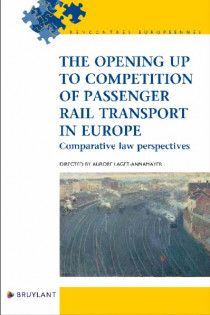
THE OPENING UP TO COMPETITION OF PASSENGER RAIL

THE OPENING UP TO COMPETITION OF PASSENGER RAIL

TRANSPORT IN EUROPE. COMPARATIVE LAW PERSPECTIVES

AURORE LAGET-ANNAMAYER

94,65 €
IVA incluido
Disponible en 1 mes.
Editorial:
BRUYLANT
Año de edición:
2024
Materia
Derecho administrativo
ISBN:
978-2-8027-7370-2
Edición:
1
94,65 €
IVA incluido
Disponible en 1 mes.

The opening up to competition of passenger rail transport is one of the key issues in Europe, both in view of the completion of a common European railway market and regarding the objectives of sustainable mobility and a climate neutral economy by midcentury defined within the European 2019 Green Deal.

The railways market was one of the last infrastructure-based sectors to be covered by EU law. It is true that since its creation in the 19th century, rail transport has always been an issue for governments, as a symbol of public service. It was only in 1991 that the EU initiated the transformation of the sector and its opening up to competition with the first Railway Package. The fourth railway Package, adopted in 2016 has fully completed this liberalization process for national passenger transport.

Seven years after its adoption, the EU regulatory framework for the railways sector has now reached maturity. It is therefore a perfect moment for an evaluation of the process, as competition in passenger services is emerging, including in the late comer members states.

How effective actually is this opening up to competition in Europe? In order to get a precise view of the diversity of situations in Europe, this book focuses on the legal framework of the railway sector in the most relevant European States (Germany, Austria, Spain, France and Italy) and on how the competition has been introduced. It then reviews the litigations arising from the opening up to competition at both the national and European level.

This publication is the outcome of a conference organised at the Paris Dauphine-PSL University on 3rd February 2023, directed by Professor Aurore Laget-Annamayer and bringing together academics as well as public and private actors. It is aimed for all those interested in the evolution of the railways sector, including students, academics and professionals. By exposing the strengths and weaknesses of its opening up to competition, it should contribute to a better understanding of a sector whose role has become essential in view of the ecological transition.

Artículos relacionados

  • EU ADMINISTRATIVE LAW
    PAUL CRAIG
    The third edition of EU Administrative Law provides comprehensive coverage of the administrative system in the EU and the principles of judicial review that apply in this area. This revised edition provides important updates on each area covered, including new case law; institutional developments; and EU legislation. These changes are located within the framework of broader dev...
    Queda 1 en Stock

    102,00 €

  • ESTUDOS DE DIREITO DA UNIAO EUROPEIA
    OLIVEIRA PAIS, S.
    Queda 1 en Stock

    17,58 €

  • ON ACCURACY OF EUROPEAN AI LAW
    WEUTS, R.
    Artificial intelligence does not necessarily do what we want, rather what we ask. This has to do with accuracy, which is not a singular thing. This book describes the different aspects of accuracy defined in technical literature and which of those are reflected in European AI law.The work provides a framework to describe different aspects of accuracy and identifies five core te...
    Disponible en 1 mes

    160,00 €

  • ADVANCING CIRCULAR ECONOMY THROUGH PUBLIC PROCUREMENT
    IURASCU, A.
    “How can public procurement become a true force for advancing the circular economy, beyond greenwashing and vague sustainability claims?”This book answers this question and provides a clear doctrinal legal analysis of public procurement as a strategic instrument to foster circular economy objectives. It explores overlapping sustainability concepts, revealing that circularity is...
    Disponible en 1 mes

    110,00 €

  • THE HUMAN EMBRYO IN VITRO
    MCMILLAN, C.
    The Human Embryo in vitro explores the ways in which UK law engages with embryonic processes under the Human Fertilisation and Embryology Act 1990 (as amended), the intellectual basis of which has not been reconsidered for almost thirty years. McMillan argues that in regulating 'the embryo' – that is, a processual liminal entity in itself - the law is regulating for uncertainty...
    Disponible en 1 mes

    55,00 €

  • LEZIONI DI DIRITTO DEI CONTRATTI PUBBLICI
    SPASIANO, M. / CALABRÒ, M.
    Disponible en 1 mes.

    85,00 €