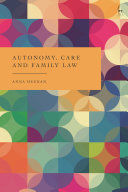
There is a tension at the heart of family law and policy between the increasing influence of individual autonomy and the demands of caring for children. Individual autonomy envisages decisions made in one's own best interests, whereas decisions around care are often made for the good of the family, and may conflict with the caregiver's individual interests. Whereas individual autonomy valorises economic self-sufficiency, caregiving responsibilities constrain choice and conflict with paid work. This book explores this tension to consider how, given changing social trends, family law and policy should take account of caregiving responsibilities on parental separation. Crucially, it suggests that we need to rethink family law by placing care at its centre.
This book draws on original empirical data to explore the experiences of parents in England and Wales, where the division of paid work and care is considered a choice, and Sweden, where parents are encouraged to work full-time, supported by wellfunded state childcare. This comparative perspective sheds light on whether the clash between the ideas of autonomy and care could be reconciled in a more gender equal society.