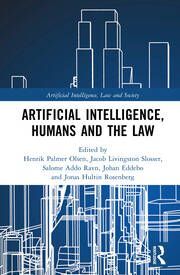
PALMER OLSEN, H. / LIVINGSTON SLOSSER, J. / ADDO RAVN, S. / EDDEBO,J. / HULTIN ROSENBERG, J.
PART I
AI Agents in Laws Empire: An Introduction to Law and the AIHuman Relationship
Jacob Livingston Slosser, Henrik Palmer Olsen, and Salome Addo Ravn
1 Large Language Models and Linguistic Understanding
Thor Grünbaum and Anders Søgaard
2 The Myth of Artificial Creative Agency
Johan Eddebo
3 The Human Free Will Debate, Autonomous Artificial Systems, and Artificial Suffering
Oliver Li
PART II
4 Children as the Others of Technology Regulation
Susanna Lindroos-Hovinheimo
5 Engaging with Non-Minds and Hybrid Others Philosophical Perspectives on AI and Automated Decision-Making
Sille Obelitz Søe and Rikke Frank Jørgensen
6 Im Sorry to Hear That You Are Feeling Bad: The Artificiality and Otherness of Chatbot Interaction in Digital Public Administration
Riikka Koulu and Ida Koivisto
PART III
7 Two Routes to Legal Personhood for AI Entities
Lars Karlander
8 Legal Personhood for AI Systems?
Léonard Van Rompaey and Henrik Palmer Olsen
9 Merging with AI: Subtle Consequences and Dubious Agency
Yulia Razmetaeva
PART IV
10 Legal Personality for AI Systems and Robots from a Belgian Civil (Extra-Contractual) Liability Perspective: Some Food for (Interdisciplinary) Debate
V. Schollaert and J. De Bruyne
11 Criminal Justice, Artificial Intelligence, and Parity in Sentencing
Jesper Ryberg
12 Rule-Based AI as Transparent, Accountable and Adaptable Computational Interpretations of Law
Thomas T. Hildebrandt
PART V
13 If Humans and AI Disagree: A Political Approach to Existential Risk
Hans Agné
14 The Democratic Agency of AI
Jonas Hultin Rosenberg
15 The Rule of Law after the Anthropocene
Vincent Chiao
This book takes up the contentious issue of artificial intelligence (AI), and more specifically the evolving nature of AI-mindedness, as a legal entity in society. With the increasing potential of AI suggested by the recent surge in creative and administrative tools and large language models, there is a growing concern about the ethical and legal implications of incorporating AI into society. As these systems become even more powerful and their ability to mimic human output grows, the question of whether and how to attribute mental states to AI, even in its most nascent form, has become a pressing concern. It is, for example, unclear what kind of mind AI might be capable of and therefore what the proper legal analogy might be for how we attribute reasoning capability, intent, responsibility, liability, agency, and so on, to it. This book contributes to this new and important area by bringing together front-line research from diverse fields on the topic of understanding AI-mindedness, and how it and our relationship to it might be regulated. Through a collection of chapters, written by experts from law, public administration, tort, psychoanalysis, philosophy, linguistics, computer science, and political theory, this volume offers an insightful examination of current research, theoretical frameworks, and practical applications that are shaping the AIhuman relationship. This book will be of considerable interest to scholars and researchers working in legal theory, socio-legal studies, law and technology, and science and technology studies.